Did Barack Obama Rape a Kitten?

help me kitten

Fifteen cats were sighted near the White House this afternoon. A reader reports that allegations may have surfaced concerning the president’s rapage of felines. Calls to the White House have gone unanswered.

Before you question my reporting ethics, let me remind you how much you paid to read this blog. Yeah, you’re not the customer and I owe you nothing. The real customers here are my paid advertisers, and they want impressions to place their ads against. They rarely make a qualitative judgment about what content their ads appear next to.

Here:

PAID ADVERTISEMENT
PAID ADVERTISEMENT

TechCrunch, Forbes, Buzzfeed, Re/code. They all rely on advertisers for revenue, which means that their sole purpose in life is not to inform, but to linkbait. The Financial Times features ads for Cartier watches and chartered jets; its articles are crafted to bait rich people. TechCrunch runs ads for cloud services. Huffington Post displays ads for Seven Weird Tricks to Reduce Belly Fat.

Ryan Holiday ran the PR campaign for Tucker Max. Tucker Max was an average 20-something with a mediocre book and a terrible movie, until Holiday instigated a bunch of media coverage based on fabricated events. If you’ve ever heard of Tucker Max, you can thank Ryan Holiday.

This is a summary of Holiday’s book on media manipulation. I present his tactics out of order because I think it makes more sense this way.

    9. Make stuff up. Everyone else does. Bloggers (by which I mean writers on any ad-supported publication – I don’t think Buzzfeed or TechCrunch posts count as “journalism”) get paid by the pageviews generated from each post. A Gawker writer churns out 12 posts a day and makes an average of $8 per post. Nobody has time to research 12 articles a day. They don’t even have time to write 12 articles a day — most of it’s plagiarized.

    9.5. News trickles up. TechCrunch might not report something that an anonymous tipster sends in, but they’ll copy something that was reported by the San Mateo Daily Journal. And the San Mateo Daily will report a story from a random email, because they’re a crappy local paper.

    Ryan Holiday emailed a bunch of local news reporters around the country pretending to be a college student staging a feminist protest against Tucker Max’s movie. National news reporters picked up the story that protests were being organized on college campuses around the country. Then college students began staging real protests.

    2. Feed the sources that reporters use. Push press releases onto PRWeb. It costs $99, and PRWeb is automatically syndicated by Associated Press and fed into Google News. Pretend to be an expert by answering questions on HelpaReporter.

    3. Stuff that makes people angry spreads the fastest. If you can’t come up with something divisive, try something shocking.

    4. Be evasive and misleading. Start a petition titled “Stop Marc Andreessen from Using LP Funds to Pay for Illicit Affairs” and tell local news. Let writers report the most sensational angle they can find.

    8. Make sure the story is simple enough to fit within 100 words. Nick Denton, founder of Gawker, says the ideal Gawker post is 100 words, 200 max.

    5. RSS is dead. Nobody subscribes to anything, so blogs care less about their reputation than they do about creating viral posts. News spreads through Twitter, not RSS feeds.

    6. People tweet headlines. Make it controversial and throw in big names for SEO. News bloggers don’t expect the tipster to write the headline for them, but hint at it in the tip.

    7. Buy traffic for your article. Use StumbleUpon or Outbrain, show these news sites that your story is a reliable traffic draw so they will write follow-on stories in the future.

    1. If you are looking for positive PR, bribe bloggers. Send them product samples, swag, whatever. They’re poor and can’t afford nice things.

So did the president rape a kitten? I don’t know, whatever. We’ll have more details as the story develops.
Screen-Shot-2012-06-20-at-12.41.26-AM-Jun-20-2012-300x408

If Other Industries Were Like Sand Hill Road

rosewood

If we thought of farming like we do venture capital: Fred buys ten dairy cows. Six cows die. One produces milk. The other three cows don’t produce milk but might be useful for plowing a field. Fred sells these cows to Yahoo.

If doctors treated patients the same way investors treat founders: Mark goes to the doctor to find out if he has cancer. The doctor asks Mark to remove all his clothes and bend over. Mark asks the doctor for his diagnosis. The doctor says it’s too early to tell, come back when eight other doctors say you have cancer. The doctor tells Mark’s friends what Mark looks like naked.

If we thought of school grades like we do venture capital performance: Miss Bowman gives her class a standardized test. 30% of her students do well. The other 70% fail and drop out of school. Miss Bowman takes the average score of the remaining students and announces that her class outperforms all the other classes. Parents fight to get their kids into her class.

If the Federal Reserve was controlled by Sand Hill Road: Janet creates a math problem and calls it a new form of money. Janet convinces all her friends that this is now money. Warren Buffett tells Janet that this is not in fact money. Janet calls Warren an old man who doesn’t understand technology.

If we valued public companies like private companies: Bill buys two shares of AAPL for $100 apiece. Bill waits until the markets are closed, and then sells one share to John for $1000. Bill announces on TechCrunch that Apple has a market cap of 6 trillion.

If we thought of food prices like we do startup investments: Josh buys a donut for a dollar. Brad sees this and buys a donut for five dollars. The donut store owner realizes that people like his donuts, so he sells a third donut to Marc for fifty dollars. Marc is stoked that he managed to get a donut at all, because the consensus is that donuts are a Very Good Deal.

If we thought about car repair the way LPs think about their investments: Mary takes her car to a repair shop. The mechanic tells her to come back for the car in ten years. He then hires 20 female executive assistants and takes a sledgehammer to Mary’s car. When Mary is finally allowed to pick up her car, the mechanic hands her two halves of a side panel and tells her to refer her friends.

If pet food companies used the same business model as startups: Jim creates a dog food factory and gives away dog food for free. 450 million dogs line up for free dog food. Purina Dog Chow understands that non-paying dog food consumers are currency, and buys Jim’s factory for $42 per dog.

If repairmen took their jobs as seriously as VCs: Joe is a plumber. Joe spends his days looking at Flipboard and arguing about Bitcoin on Twitter, to maintain finger on the pulse of plumbing and whatnot. Rumor has it that Joe also does some plumbing stuff, but no one has yet to see it happen.

Inspired by and with great respect for Morgan Housel’s If Other Industries Were Like Wall Street.

How to Bootstrap Like an Entitled Shit

For the past couple days, the co-founder of a16z* and Y-Combinator-backed Genius.com has been publicly fellating himself over his guide on How to Shoplift From Whole Foods. He calls it “bootstrapping”.

First of all, the guide isn’t very good. Mislabeling your bulk food purchases? Pocketing fruit from the children’s bin? That’s about as clever as snatching grandma’s purse.

But poor Mahbod needs to satiate his paleo diet on a bootstrapped budget, and a discount grocer just won’t suffice!

We admire hustle, we love stories of how entrepreneurs resort to creative methods to make ends meet. The YC application specifically asks founders to describe a non-computer system they have successfully hacked.

A hack is an innovation that allows you to get around annoying rules that you don’t think make sense for your situation. Many recent startups gained acclaim because they provide fantastic hacks.

Uber is a great example of a hack: Taxicab licensing rules are annoying and only serve to make a few people’s lives better (the taxi medallion owners) while making many people’s lives worse. Waze allows drivers to report speed traps and police checkpoints because we all know that CHP officers only issue tickets to fill their quotas. Airbnb shirks rental and zoning regulations, and the world is arguably a better place for it.

Is shoplifting a “hack”? Maybe Mahbod here doesn’t think that shoplifting rules make sense for his situation. Given that he has a law degree from Stanford, I find that hard to believe.

*Did Andreessen Horowitz know that their $55(?)-million investment was being used for Mahbod to personally expense $100 a day at Whole Foods? Dear pmarca: If you give irresponsible children (and Mahbod claims to be a “child”) large sums of money, you are not allowed to complain about startup burn rates.

Screen Shot 2014-11-16 at 12.26.18 PM

How 20-Minute Options Make the World a Better Place

getmet

Suppose that you are a happily married and risk-averse individual. Being risk-averse, you prudently take out a life insurance policy on your spouse. Things are going splendidly until one day OH NO your spouse accidentally gets thrown in front of a bus. And dies.

You’re pretty bummed about this, but your grief is somewhat mitigated by that multimillion-dollar life insurance policy. This is called risk-hedging.

Now, suppose that you also own a diverse basket of stocks that look like the S&P 500 index. You know that markets sometimes suffer downturns and you would hate to have your portfolio wiped out. You purchase some S&P 500 options so that, if your stock portfolio gets demolished in a market crash, you can sell the S&P 500 index at a price that is acceptable to your risk profile. This is another form of risk-hedging.

Nobody knows where the market’s gonna go. Maybe you like the perceived safety of long-dated options. If you’re Nassim Nicholas Taleb betting on black swan events, you buy long-dated options on the cheap hoping some won’t expire worthless. Or maybe you prefer to buy something closer to expiration so your cash isn’t tied up.

Think back to the life insurance policy you had on your spouse. Maybe it was a bit silly to pay monthly premiums for all those months your spouse didn’t die. Maybe you should have waited until 20 minutes before pulling the plug to purchase that life insurance policy*.

Nadex, the North American Derivatives Exchange, opened trading on 20-minute options last week. Previously, their shortest-term contract was two hours. However, Nadex had long observed that most trading activity occurs in the minutes before expiration. Instead of having trading volume surge every two hours, why not promote this same activity every 20 minutes?

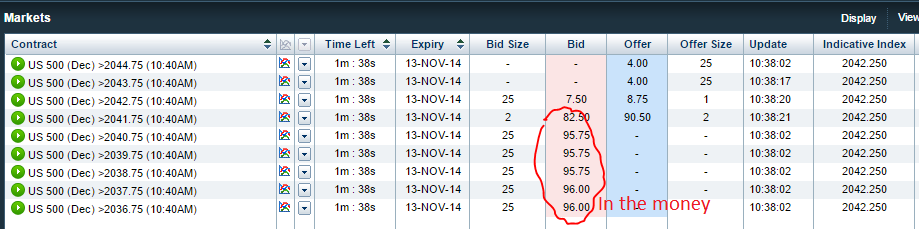
Trading activity on S&P500 options on Nadex, just before expiration
Trading activity on S&P500 options on Nadex, just before expiration. The rightmost column shows the value of the underlying index. The circled bids are the options that expired in the money.

Critics made some noise about how this amounts to little more than gambling. In a zero-sum game like the options market, every individual who buys an option to lower personal risk has a counterparty taking an equal and opposite risk. The market allows those who don’t want risk to purchase downside protection from those who do. By giving individuals the freedom to tailor the world to their personal risk preferences, the options market improves social welfare and ensures peace and prosperity for all.

*It might be hard to find an insurer for your spouse on life support, but surely there must be someone out there willing to bet on the off-chance that your spouse makes a miraculous recovery once disconnected from the ventilator.

See Also:
Short attention span trading: 20-minute option use surges –CNBC
Ask A Banker: What’s A Derivative? –npr

This Does Not Constitute Investment Advice

This is one of the finest films ever made. Ray Dalio should have won so many Oscars.

https://www.youtube.com/watch?v=PHe0bXAIuk0

If you don’t have half an hour to spare, here are the three key takeaways:

  • Don’t have debt rise faster than income.
  • Don’t have income rise faster than productivity (you’ll price yourself out of the market)
  • Do all that you can to raise your productivity.

These three rules apply to governments, corporations, and individuals.

By the way, the only time a capital outlay can be called an “investment” is when it is used to raise future productivity. That stock portfolio of yours is really a high-maintenance savings account, and your stock purchases are merely trades.

Other things that are not investments: insurance policies, art collections, personal vehicles, houses, derivatives.

Things that are: undeveloped property, private businesses, a personal vehicle used by an Uber driver, education.

Sleep is another great investment. The best investments in life are free.

See Also:
Your portfolio is a place where you are simply trying to grow your savings at a reasonable rate without exposing it to excessive permanent loss risk or excessive purchasing power loss. It’s not a place for gambling or getting rich quick.” –PragCap

PS. Things look different. I finally got around to making this site mobile-friendly.