The Difference Between Design and Aesthetics

I try to stick my USB cable in upside-down about 18 times a day. That’s probably 30 seconds wasted each day, 3.5 minutes a week, over 3 hours a year that I spend jamming a plug the wrong way into a hole. I could have spent that time sleeping.

The USB plug is a fine example of poor design.
usb plug
It’s not my fault I keep trying to plug in my phone charger upside-down. The human brain is actually very well-designed, no matter how you might suppose that design came about. There is no such thing as human error, only design error. A USB plug could be greatly improved if it came with “THIS SIDE UP” written across the top, but that would not be aesthetically pleasing.

Here is an example of good aesthetics:

tubatoilet

It’s a row of tuba-shaped urinals in a jazz lounge restroom. Beautiful, right? But terrible design. Urinals are supposed to have backboards for users to take bank shots. I don’t have a lot of personal experience, but I assume it’s quite difficult to get a direct shot after a night of Irish Car Bombs. That’s gonna be really hard to clean up.

Don’t sacrifice design for aesthetics.

What Does Full Stack Mean Now?

pancakes_2

Once upon a time, “full stack” meant coverage of the technical layers, from server to user interface. That’s gotten too easy.

Chris Dixon and Balaji Srinivasan recently explained that the new full-stack approach is to build a complete, end-to-end product. One that covers all aspects of an industry: Technology, design, marketing, supply chain management, sales, partnerships… The best way to disrupt an industry is to rebuild it. New startups must go for the full Apple.

Airbnb is becoming a hospitality company, a standardized service that aims to control the customer’s travel experience from touchdown to departure. Other examples cited include Tesla, Warby Parker, Uber, and Nest. These are all clearly lifestyle companies. A full stack startup controls how customers live their lives.

Next month: Full stack startups control customers’ bodily functions.

Crowdsourcing an Efficient Market

Public hotel chains including Hilton, Marriott, and Wyndham are now implementing franchise growth strategies to ramp up a pipeline of new hotels and rooms in response to the strong recovery in the travel industry.

This recovery has been underway since 2009.

Source: Tourism Economics

Industry disruptors like Airbnb and HomeAway spent the last five years eating the hotel industry’s lunch while hotel chains were still loading their muskets.

Construction takes time, and hotels can’t move that quickly. Crowdsourcing provides a highly-liquid, dynamic supply. Travelers don’t have to wait half a decade for Airbnb hosts to build new rooms to meet their needs. In times of low demand, hosts take their rooms off the market while hotel chains go through bankruptcy and consolidation.

Source: American Hotel & Lodging Association
Average Hotel Room Occupancy Rates. Source: American Hotel & Lodging Association

People have made noise about Uber’s surge pricing and Lyft’s Prime Time price increases, but this is how the principle of supply and demand works. How much would someone have to pay you to schlep passengers on New Years’ Eve? Or in the aftermath of a hurricane?

uber-surge-pricing

By providing higher incentive to drivers during times when they would probably rather be doing other stuff, supply increases to match the number of passengers needing rides. With a potentially limitless source of drivers, we quickly find an efficient market.

Regulations that cap prices or artificially limit supply enforce an inefficient market where supply and demand never meet.

Cities like San Francisco and NYC are finally issuing more taxi medallions for the first time in years. At the same time, GDP data show that prices for traveler accommodations are falling, and we’ll soon see a glut of empty hotel rooms. It’s hard to create an efficient market when moving at Gatling-gun pace.

implosionsboardwalk

The Best Investment is to Hire a Team of Lobbyists

Late last year, a leaked screenshot of Uber’s Internal Revenue and Ride Numbers indicated that they were on track to make more than $200M in revenue for 2013.

They started last year serving 14 US cities and ended the year with 25. Given unchecked expansion, it won’t be long before Uber is eating a substantial chunk of the $11B taxi and limo industry.

Ridesharing proponents argue that the taxi industry should take this as a cue to reform their third-world system. If hailing a cab in SF wasn’t such a crappy experience, nobody would need Lyft or Uber.

la-me-ln-uber-lax-20140124-001

Unfortunately, repairing the existing system is a poor investment of resources, from the perspective of industry incumbents.

A far more effective option: Spend a few hundred thousand hiring a team of lobbyists to further your cause. The lobbying team identifies key policymakers, and throws fundraisers to help them raise campaign money. Your team becomes a big donor, the candidate is elected, and industry regulation is at your mercy.

Last week, the Seattle City Council whimsically voted to enforce new legislation that will limit app-based transportation companies to 150 cars on the road at any given time in an artificial suppression of supply.

ubereverywhere_template_r1_OL

If new market entrants are blocked, the hundreds of thousands spent influencing public policy can lead to billions saved in the long run for incumbents. Former lobbyist Jack Abramoff assures that a successful lobbying effort achieves returns that are multiplied hundreds of times over the initial investment. This is even better than the return that Uber’s Series A investors got.

Transportation lobbying is a $230M industry with customers from all the major automotive manufacturers, labor unions, and transit authorities. Disruptive businesses claim that the current transportation system is broken, but when hiring lobbyists represents a better financial choice than trying to fix the transportation industry, maybe something else is broken.

See Also:

Corruption Index Indicator: Cities That Ban Ride Sharing To Protect Taxi Incumbents –techdirt

How Corruption Is Strangling U.S. Innovation –HBR

abramoff

Down and Out in Baja Mexico

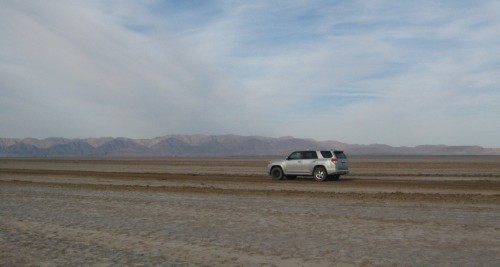
I was transporting a Toyota 4Runner from New Mexico to Mountain View and decided to take the scenic route through the canyons of Baja. Try it sometime, it’s worth it. After some exuberant offroading, the left front tire went flat with a grain-sized hole in the sidewall.
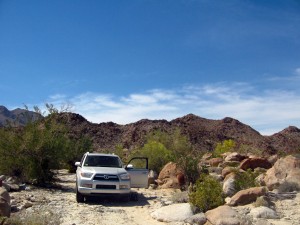
IMG_8286x

Attempts to reinflate with a portable air compressor led to the orifice exhaling in my face. I pushed a rice-shaped pebble into the hole and inflated again. A 200-meter crawl and we were flat once more. Useless. I would have to cross rim-crushing rockfalls before returning to pavement.

Rumor had it there was a full-sized spare attached to the underside of the truck. Hidden behind the rear interior panel was a bottle jack. Beyond that, I was on my own.

Without knowing what to look for, I flung everything out of the car. I cursed the vehicle, I cursed its owner, I kicked the tires and cursed Toyota and Bridgestone and the Powers That Be. But who was I kidding? All the tools for changing a tire could be laid out in front of me, and I wouldn’t have the faintest idea what to do.

A battered pickup full of locals rambled by and I pleaded for help in broken Spanglish. Lo siento, they shook their heads.

I pulled out my GPSMap and tried to estimate how long it would take to hike to the main road. What would I do then? Call AAA? It was high noon on a Sunday. No tire shops were open.

Sometime later, I was kicking up sand in resignation and a lone motorcycle puttered in the distance. It echoed through the canyons, growing louder until it pulled up alongside the 4Runner.

A hefty local dismounted. His pants were held up by a steel link chain and his hair was held down by a dirty cap.

I asked for help again in Spanish. He replied in English.

He called himself Demetrio and walked around the car, peering in the windows.

What are you doing here by yourself?

I had no answer.

The Sinaloa grow marijuana in these canyons, you know.

I did not know that.

What year is this, a 2008?

2010, I said.

He nodded. You must be very rich.

But it’s not my car… I stopped because it didn’t matter. Even if I had shown up in my ratty Ford Escape, I would still be very rich by his standards.

I have tools at the Hacienda where I work, Demetrio said. It’s not far, but you can’t stay here by yourself.

I couldn’t very well leave the truck either. It provided security. I weighed my options. Would my chances of disembowelment be higher if I rode away with a random stranger, or if I hung around and awaited an encounter with the local drug cartel? Was this my one chance for rescue? What if Demetrio left and never came back?

Fear of abandonment won out. I set my Garmin to record a trail of breadcrumbs and climbed aboard his bike. If I needed to make a run for it, at least I would be able to find my way back.

The Hacienda was a resort next to an olive plantation, where Demetrio had worked for decades maintaining the guest facilities. We retrieved a large red toolbox from the back of a white cargo van.

The box contained a mishmash of loose sockets and wrenches of all sizes. Like a child’s tool set, assembled from his father’s cast-offs. Odd-sized metrics, SAE sockets, stubby wrenches with half-inch drives.

I pressed the metal chest against my stomach and clung to the bike’s rear luggage rack all the way back to the truck.

We moved my vehicle to a flat patch of terra firma. Demetrio lifted the front of the car on the little jack and neatly swapped the flat for the spare.

I asked him why he was out in the canyons.

I’m going to my oasis, he said.

I want to go to an oasis too.

We left the 4Runner and headed into the canyon. Demetrio spoke over the flutter of his small-bore single.

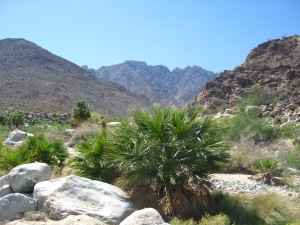
He told me about his family. His grandfather owned the land around Carrizo Canyon. His father was Tarahuemaran. He was the youngest of thirty-five (35!) offspring. From different mothers, of course, but they all shared his father. He had never met any of his siblings. He had a 16-year-old daughter and a two year old grandson. He worried about his daughter because her boyfriend beat her. He wanted to help her but she refused to speak to him — her mother had told her lots of angry stories about Demetrio. He no longer spoke to the mother of his child and he was desperately lonely. He was lonely because he lived and worked at the Hacienda.
IMG_8282

We arrived at a cluster of palms over a tadpole’s swimming hole. Demetrio’s oasis.

I don’t understand, he finally said. Why are you talking to me?

Why wouldn’t I talk to you?

Because you are young and rich and beautiful.

HA. At home, I am none of the above.

The rich gringas, he said. They treat me like I’m a lizard.

Given the circumstances, who was the lizard here? What does it matter when I’m stuck in a canyon with a flat tire?
IMG_8646

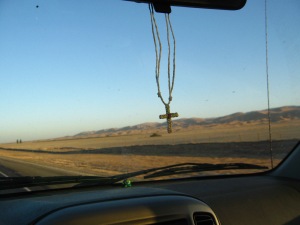
Demetrio wanted to give me something before I left. It was a small white cross. He braided these out of plastic grocery bags to sell to tourists. I offered to buy it, but he didn’t want my money. He only wanted the same thing anyone wants, to feel like he was worth something.
IMG_8309