The Risk of Risk-Avoidance

A recent study from UBS Wealth Management Americas shows that kids aged 21 to 36 have 52% on average in cash.

Unless you are about to buy a house, execute a major drug deal, or flee to Mexico, there is no reason to have 52% of your assets in cash.

Young people avoid investing in stocks because they endured the dot-com crash and financial crisis in their formative years. The market seems risky.
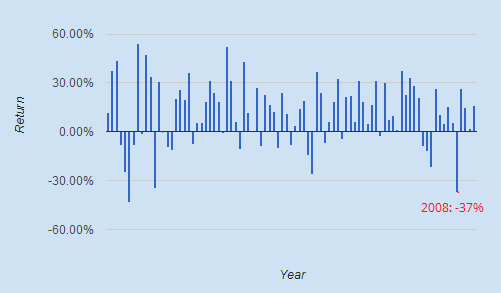
S&P 500 Index Real Returns, 1926-2012. Holding cash would have beaten the market in 2000, 2001, 2002, and 2008.
S&P 500 Index Real Returns, 1926-2012.
Holding cash would have beaten the market in 2000, 2001, 2002, and 2008.

But holding cash is equivalent to investing in a negative-yield bond. This cash holding would have underperformed the S&P 500 by 30% last year. An investor who chooses this zero-return strategy runs a risk of not being able to save enough for retirement.

People often confuse uncertainty and risk, when the option with the most certainty is often the riskiest. A cash allocation is a certainty that depreciates at the rate of inflation.

Higher education is also a frequently-mistaken risk aversion strategy. There is a lot of certainty associated with an advanced degree. An engineering PhD at least guarantees you a six-figure salary at a boring company.

However, just as a 0% return ended up being a really lame outcome for 2013, a career at Intel might end up being a really lame outcome for an EE PhD. By choosing a low-risk strategy for six years, the PhD student gambled away the most priceless asset of all.

Sometimes the biggest risk is to not take any.

Making Time to Say No

persistence_of_memory_dali_lowestres

Focusing is about saying no. And you’ve got to say no, no, no. When you say no, you piss off people. –Steve Jobs

From Randy Pausch‘s time management lecture, via Warren:

Verbs are important: You do not FIND time for important things, you MAKE it. And you make time by electing not to do something else. There’s a term from economics that everybody should hold near and dear to their heart, and that term is “opportunity cost”. The bad thing about doing something that isn’t very valuable is not that it’s a bad thing to have done it. The problem is that once you spent an hour doing it, that’s an hour you can never again spend in any other way. And that’s important.

When can we say yes?

Everybody has good and bad times. The big thing about time management is, find your creative time and defend it ruthlessly. Spend it alone, maybe at home if you have to. But defend it ruthlessly. The other thing is, find your dead time. Schedule meetings, phone calls, exercise, mundane stuff, but do stuff during that where you don’t need to be at your best.

According to Github, my dead time is from 5am to 8am. If you need anything from me, schedule it during those times :). Any other time, I’m probably coding.

Elaine's Github Punchcard
Elaine’s Github Punchcard

See Also:
Randy Pausch – Time Management — University of Virginia, November 2007

Silicon Valley is the New Wall Street

Once upon a time, Silicon Valley was a safe haven for socially subpar tech people. They lived in humble garages in the South Bay and built cool things for the sake of building cool things. The transistor. Apple I. Netscape.

Google HQ, 1998
Google HQ, 1998

The world loved the cool things they built. The geeky kids of Silicon Valley made money, lots of it.

Then the beautiful people showed up. MBAs and smashmouth capitalists. They wanted to build cool things too. Not for the sake of building, but to make money. They didn’t live in garages, because beautiful people don’t hide in garages. They live in high-visibility metropolises at the top of the peninsula.

More than 1,200 of Google’s 47,500 current employees formerly worked for one of the top 10 global investment banks, according to LinkedIn. The top banks also incubated at least 750 current Apple employees, 175 Facebook employees, and 260 Yahoo employees. Travis Kalanick, chief executive officer of the ferociously expanding Uber, has said that between 10 and 15 percent of his hires come from the financial services industry, with a full 5 percent coming from Goldman Sachs alone.

The new businesses don’t make users fall in love with their products. They churn out slick consumables that evoke the emotional connection of a quick handjob in a truck stop bathroom stall.

The Valley really is not so different from Wall Street. The core business model involves gambling with rich people’s money under the guise of wealth management. The startup founders, they’re just junior traders. They work 14-hour days and spend $2000 a month to carve out some sleeping space in a shared building.

Occupy Twitter
Occupy Twitter

And sooner or later, something will pop and the money will vaporize, because that’s what happens when everyone gets greedy. The Wall Street immigrants will return home, the San Francisco natives will get their rent-controlled apartments back, and it’ll only be a matter of time before the next hot spot emerges.

busillo

See Also:
Go West, Young Bank Bro –SanFrancisco

Standards of Living

If me and my current standard of living were transported back a few hundred years, I would be revered as royalty. I have electric lights and a telephone line and a horseless carriage! I can buy enough food to make me fat and I have all the world’s books at my disposal.

I would be proclaimed King of all Humans and worshiped as a deity.

Sure, that kinda looks like me
That kinda looks like me

If me and my current standard of living were transported back a few hundred years, I would be cast in a position below that of indentured servitude. I have to be on call 20 hours a day, every day of the week. I don’t own my life, because my boss does. Or my customers do. Or my investors do.

Medieval laborers only worked 175 days out of the year. That was approximately enough to produce what they needed. Now we work 250 days a year.

paysans01

The luxury is that we now have the freedom to choose how we want to live. We can opt to live like they did in the Dark Ages, but we never do. Feudal serfs got to take afternoon naps. I can’t do that, because my phone won’t shut up.

See Also:
overworked american

The Candy Crush IPO: Zynga Redux?

Candy-Crush-Title

King, the makers of Candy Crush, filed to raise $500 million in an IPO yesterday. Of course, noisemakers are comparing this to Zynga’s billion-dollar IPO back in 2011.

ZNGA is dead to investors now. Just for fun, let’s pull up their SEC filings from 2011.

Risk Factors cited in Zynga’s S-1 filing (I’m only copying the top 5):

  1. If we are unable to maintain a good relationship with Facebook, our business will suffer.
  2. We operate in a new and rapidly changing industry, which makes it difficult to evaluate our business and prospects.
  3. We have a new business model and a short operating history, which makes it difficult to evaluate our prospects and future financial results and may increase the risk that we will not be successful.
  4. We rely on a small percentage of our players for nearly all of our revenue.
  5. A small number of games have generated a majority of our revenue, and we must continue to launch and enhance games that attract and retain a significant number of paying players in order to grow our revenue and sustain our competitive position.

Excellent foresight on Zynga’s part. Poor execution of risk management, because all of those risks materialized.

farmville-660x377

Here’s what King Digital Entertainment, the makers of Candy Crush, cite as risk factors in their SEC filing.

  1. We have experienced significant rapid growth in our operations, and we cannot assure you that we will effectively manage our growth.
  2. A small number of games currently generate a substantial majority of our revenue.
  3. We must develop new games and enhance our existing games so that our players will continue to play our games and make purchases of virtual items within our games.
  4. We face significant competition, there are low barriers to entry in the digital gaming industry, and competition is intense.
  5. If players do not find our casual game formats compelling and engaging, we could lose players and our revenue could decline.

Can King Digital Entertainment continue to churn out growth where Zynga could not? Where PopCap could not? Where Jive could not? Let’s find out!

candy-crush