What You Can Learn from Startup Job Listings

Paul Graham wrote (13 years ago) that you can learn a lot about startups by reading their job listings [1].

The companies looking for C++ or Java developers were generally slow-moving and useless, because programming in Java is like throwing down a boat anchor. The ones looking for Perl or Python programmers could prototype quickly. A startup looking for Lisp hackers would be most formidable.

But now with so many Platform-and-Infrastructure-as-a-Service offerings to facilitate quick deployment, rapid prototyping has become the default. Anyone with a modicum of computer knowledge can put together a mobile web app in a day.

We can still learn a lot from startup job listings based on their programming skill requirements:

    Ruby on Rails – The startup’s main product involves web development and is unlikely to introduce technical computing. Ruby as a language is more symbolic than lexical, and teams that employ Ruby tend to be visual and creative.

    Python – Built for data analytics and scientific programming. The developers are practical, probably academic, and appreciate structure and consistency. The frontend almost certainly looks like crap.

    Node.js – A language created so that frontend developers could also build server-side functionality. The company is full of hipsters in skinny jeans who don’t really know how to code, but I’m sure the UI is beautiful.

Then there are the languages designed for high-performance computing and concurrency: Go, Clojure, Scala, Erlang, Haskell (in order of trendiness).
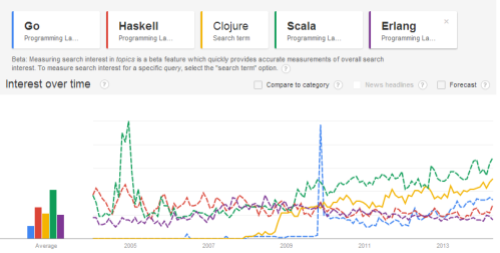
go vs haskell vs clojure vs scala vs erlang

Companies who list these skills don’t actually need programmers who are well-versed in esoteric languages; they just want programmers who care enough about programming to learn an esoteric language [2].

Our VP of Engineering at Barnacle recently submitted a hiring request. Here’s the job listing:

Senior Engineer
Required Skills:

  • Well-versed in Hadoop ecosystem technologies
  • Experience with building multithreaded and distributed systems in Haskell, Go, or Scala
  • Familiarity with information extraction algorithms, e.g. Hidden Markov Models
  • Previous experience with database integration systems (Redis, Riak, or CouchDB)
  • Solid knowledge of Linux kernel internals (process scheduler, memory management, concurrency/synchronization, memory allocation, file systems) and networking or storage subsystems architecture.
  • Must play well with others

Only some of the skills listed are actually relevant to the job. The rest guarantee that the new hire will remain delightfully single and available to work nights and weekends until IPO.

A startup  that misspells the name of the programming skill for which they are hiring, probably does not have any programmers on the team.
A startup that misspells the name of the programming skill for which they are hiring, probably does not have any programmers on the team.

See Also:
1. Beating the Averages –pg
2. The Python Paradox –pg

The Rationale Behind On-Demand Mobile Uber for Everything

on-demand mobile

It started with information. In a time when humans had to schlep to the library and look up references in a card catalog, search engines delivered the world’s knowledge with the click of a button.

Then came entertainment. Remember when we had to drive to Blockbuster, or at least to the RedBox kiosk outside of Safeway? Netflix condensed the process to three taps.

blockbuster closing

Last summer, I had a conversation with an investor who urged Barnacle to move into the local food delivery market. We need an Uber for food, he said.

There were (and still are) tons of startups scrapping to do just that. Doordash, Seamless, Postmates

None of them are very good, he said. Deliveries can take upwards of 30 minutes in the city. I ordered a sandwich and by the time it arrived the fries were all soggy.

Oh, the humanity.

Around the same time, all sorts of instant-gratification startups were closing rounds of fundraising. Uber for flower delivery, Uber for dog walking, Uber for dirty laundry. Things were looking a little ridiculous. Are startup founders soiling themselves at such inopportune times that they need on-demand dry-cleaning?

"Thanks for coming on such short notice, I just regurgitated all over my wedding dress and need this--wait a minute--Are you... flexing??"
“Thanks for coming on such short notice, I just regurgitated all over my wedding dress and need this–wait a minute–Are you… flexing??

The interesting thing is that these startups aren’t just catering to the criminally lazy. They’re collapsing entire value chains into a mobile app. On-demand mobile services deliver full-stack experiences that combine everything from discovery to confirmation to payment to fulfillment.

3-screens

Consumers have grown inured to many sources of friction: Searching for price comparisons, checking for business hours, aligning our own availability, putting on pants, and scheduling for a completion time. It isn’t until we experience something truly delightful, mobile, and on-demand, that we realize just how unpleasant the old practice really was. Full-stack services distill a series of thoughts and decisions into just one.

Our ancestors had to get off the couch and stab a mastodon to death before they could eat dinner. I’m sure even they would agree that there’s something magical about having a chicken tikka masala delivered with three taps.

See Also:
Uberification of the US Service Economy –Schlaf Notes

Human Migratory Patterns

vid_global_migration_datasheet_web-gimp3

Interesting notes:

It’s not the poorest countries sending people to the richest countries, it’s countries in transition—still poor, but with some education and mobility—that are the highest migratory contributors.

Also, nobody is going to South Asia.

Interactive chart:
Where everyone in the world is migrating — qz

Constraints Beget Creativity

Complete this drawing:

Do-it-Yourself-Doodler-1

An uninspired artist could easily come up with a solution that would not be appropriate to post here. And then there are brilliant solutions like this one by David Jablow:

5074783443_f614389661_z

Constraints can be seen as either an excuse to do something lame, or an invitation to do something extraordinary.

During the 2008 election, a couple of startup founders had some constraints. They were building a company where homeowners provided guests with an airbed and breakfast. They were also broke.

Given these constraints, Brian Chesky and Joe Gebbia created a cereal called Obama O’s. The cereal was originally intended to be given to hosts for use as a breakfast offering, but it quickly became a collectors’ item that sold for hundreds on ebay.

obamaos

In order to think outside the box, first there needs to be a box. Life is a series of real-world optimization problems where we are constantly seeking the best available solution. In the absence of boundary conditions, the solution set is infinite and no one solution is better than another.

Given a blank canvas or a pile of money, the default action is to do what has always been done. Kellogs, with its billions of cash, hasn’t made anything interesting since 1953, when it created Honey Smacks, a cereal that is 55% sugar.

00038000219573_full

I guess that’s kind of good too.

4910759678_2ddeb93bec_z

Don’t Invest in Bitcoin, Invest in Change

Last week, Marc Andreessen and Warren Buffett had an old-white-male catfight over the investment potential of Bitcoin. I think hair was pulled.

andreessen

Buffett’s take is that Bitcoin has no intrinsic value. Bitcoin is not a currency, according to the IRS. And it’s not. It cannot be used as a medium of exchange because it is not a reliable store of value. Wait, but what about the US Dollar and hyperinflation? Shut up.

To be fair, Andreessen isn’t buying up Bitcoins himself. He’s investing in the technology, including $25M in Coinbase, a Bitcoin wallet and exchange.

Either way, Warren Buffett does not invest in technology. He cites the auto industry to give insight as to why:

All told, there appear to have been at least 2,000 car makes, in an industry that had an incredible impact on people’s lives. If you had foreseen in the early days of cars how this industry would develop, you would have said, “Here is the road to riches.” So what did we progress to by the 1990s? After corporate carnage that never let up, we came down to three U.S. car companies–themselves no lollapaloozas for investors.

Buffett says that it would have been wiser to short horses, because the US Horse Population declined from 21 million to 5 million between 1900 and 1998. And Warren Buffett was probably around to do just that.

Another example is airplanes. There were hundreds of airlines and even more aircraft manufacturers last century, but only a few managed to not die. Rather than taking positions in airlines, investors should have shorted the passenger railroad industry.

There are about a bajillion Bitcoin startups right now. Most will die, but it’s Marc Andreessen’s job in life to invest in things that can die. The only constant is change.

See Also:
Why Buffett Doesn’t Invest in Technology –Henry Blodget @BI