Why Aren’t There More Female Programmers?

Paul Graham caught some flak several months ago for remarking that the reason there weren’t more female startup founders was because there weren’t more female hackers.

This is true. But why aren’t there more female hackers?

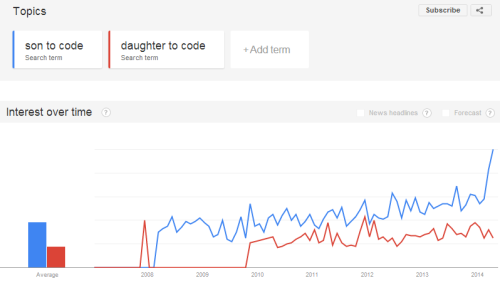
I blame the parents. What are people searching for on Google?

Capture
code

I was very fortunate that my mother enrolled me in programming classes at the local Boys Club when I was six years old. I’m not sure why; I think she just wanted to turn me into someone else’s problem for a few hours every week.

logosqr1I learned to program with the Logo Turtle. I don’t remember much from that time in my life, but I’m sure it was horrible.

As demonstrated by Google search results, parents are putting more effort into getting their male offspring to code than getting their female offspring to code. But it would be unthinkable for parents to pay less attention to their daughters when it comes to reading or math or eating your vegetables.

No six-year-old wants to sit still in front of a computer screen. I know I didn’t. But as a result, I had a useful tool in my arsenal for later in life.

Don’t give up on your daughters! (Thanks Mom :D)

See Also:
Female Founders –pg

How Deals Go Down in Silicon Valley

Over the last couple days, Semil Shah of Haystack Fund generously wrote up a series of posts describing the process behind his recent investments.

The stories generally follow a common frictionless thread, where Shah is vaguely aware of a market space, learns about a startup in that space, meets the founder, falls instantly in love, and investment babies are made.

Man, how come our deals never come so easy?

An anonymous friend who is currently raising his own round of funding helped out with some annotations to better reflect how deals go down:

The Story Behind My Investment In Refresh

by Semil Shah

About a year ago, right around the time when it seemed like every new day brought a new mobile calendar app, I wrote my weekly column on the intersection of calendars and how that data could jumpstart a third-party approach to anticipatory computing on mobile.

About a year ago around the time when all my investor friends were investing in stupid calendar apps I couldn´t understand, I finally got introduced to a great founder who was doing something in this space. I was so desperate to give him my money that I almost didn’t care whatever shit he was doing. And now I’m going to write about it in my blog, because this is the most “value” I can bring to him. 

One of my conclusions was that Apple would have to bake such a solution into they OS to offer something that’s either comparable to or orthogonal to Google Now. Since this piece, Apple purchased Cue (formerly Greplin), and it’s become evident trying to build a Google Now-like experience without the access to what Google has will produce suboptimal results.

Apple was buying companies in this space, so it was clear to me that I needed to give my money to someone. Plus if Apple was competing with Google here, other companies may bet as well. Even with a shitty product. 

Enter Refresh, which is kind of like a “Google Now, for People.” Luckily when I wrote this column, a friend of mine  told me about a stealth company he’d invested in, and that I should meet the founder. They were housed downtown, very close to me, so I met the CEO, Bhavin, for a coffee and he told me about the motivation for the product. I still didn’t realize what it was, but I liked Bhavin a lot, so we met again quickly and I saw the product in alpha. Right there and then, I blurted out, “I would love to invest.”

I told him I would love to invest. Like I tell 80% of the entrepreneurs I meet. 

That was in March 2013. It took a long time for that deal to coalesce and I just started helping out where I could.

I liked him so much and that’s why it took another 6 months to actually wire the money.  In the meanwhile I was useless… actually I may have been a source of distraction and wasted time with stupid requests. 

As a courtesy, Bhavin made me an advisor first. That was a classy move. Bhavin had a very clear vision for the product and how he wanted to get it from alpha to beta to prime time.

That was not a classy move, that was the only way to keep you involved, bastard. 

While there’s always room for perfection, I noticed early that Refresh had one of the best push notifications of any app, one that I nearly always opened given that Refresh gets you up to speed on anyone that you’re meeting. That’s still the case today. Even for someone like me that takes notes and remembers follow-ups as second nature, Refresh was a huge boost to my knowledge and EQ in meetings. I couldn’t imagine not having it on my phone.

Yes, that´s why I downloaded it 2 months ago and never used it. Not even once. 

Now, about a year later, the product is finding its groove. There’s still work to do, but some of the new power features on the Refresh profiles are amazing.

Now, after figuring out product market fit with the seed money, they have something going on. Shocking. Maybe that’s what seed money is for? 

My favorite is the “intro” email. With Refresh, an intro email is now just a few taps. It works perfectly. I’ve seen 4-5 other startups just try to productize that flow, but it was Refresh that did it. It’s that kind of precision and execution that get me excited. Refresh is a product that reminds me of one of my favorite lines from Marcus Aurelius: “The secret to all victory lies in the organization of the obvious.

I heard that in my favorite TV series, Rome. 

That, in a nutshell, is the opportunity that lies ahead of Refresh, and that is pretty darn exciting.

I’m going to get my money back!! My friend was right!! I’ve found the way to convert everything I touch into gold: I just have to follow other investors.

It's a stalker app.
It’s a stalker app.

Webvan Comes Back from the Dead

web_van_truck_MIpets_puppet.gi
A decade after the epic IPO fails of Webvan, eToys, and Pets.com, the HomeGrocer is back for more!

Here’s a brief refresher for those who have forgotten, as investors clearly have. From the New York Times, November 6 1999:

Webvan Group, an online grocer that has overcome several financial and regulatory obstacles, rolled ahead in its first day of public trading today to achieve a market value of $7.9 billion.

The company was expected to post a loss of $65 million this year — high even by the standards of Internet start-ups — and has forecast operating losses for the “foreseeable future.”

But neither problems with the S.E.C. nor loss projections have sunk Webvan, which has been the darling of an investment community intrigued by the promise of moving the grocery market to the Internet.

The stock price plummeted to 6 cents a few months later, and Webvan filed for bankruptcy in 2001.

Webvan’s founder Louis Borders is now running his own startup incubator in Palo Alto, and his flagship startup is called Home Delivery Service:

HDS claims to be environmentally sustainable. Perhaps by reusing the old Webvan trucks and bins from 2001?

The HDS website offers consumers a single online store to shop for fresh foods and general merchandise from the world’s leading retail brands.

If I were a VC, I would totally fund that pitch. A website, you say? Sign me up and let’s party like it’s 1999!

On a more serious note, we’ve learned that ideas are worthless. Execution is everything. Postmates, Instacart, RelayFoods, AmazonFresh, Google Shopping Express, Walmart To Go, all agree that on-demand grocery delivery is a good idea. But none of these services are independently profitable. Yet.

instacart app

Nobody knows for sure what killed off Webvan. Was it the Dotcom crash? Was it the billions of debt incurred during infrastructure rollout? Was it the fact that it cost Webvan $27 to fulfill an order when there were no delivery charges or minimum order requirements?

Maybe they can get it right this time around. The “patented, automated distribution technology” they cite sure sounds promising.

See Also:
Home Delivery Service: An Introduction

The Story of Adult FriendFinder

ff

In 1996, a Stanford PhD student created a website with the most innocent of intentions. It was called FriendFinder, because he wanted to make friends on the internet. CS students sometimes have difficulty making friends.

To the guy’s assumed disappointment and surprise, people uploaded a bunch of homemade porn onto his site. That’s a good way to make friends.

Anyway, FriendFinder CEO Andrew Conru then created Adult FriendFinder to give these deviants a separate-but-equal place to go. Kind of like how SF set aside the Tenderloin so poor people would stop hanging out in Union Square. And like how Los Angeles set aside Skid Row to keep homeless people out of Beverly Hills.

The easiest way to make troublemakers go away is to give them a place to go. Adult FriendFinder quickly overshadowed regular FriendFinder, and I don’t know if Andrew Conru ever found himself any friends. I hope so.

In light of these anecdotes, I’m going to leave this right here. Just in case.

drugrabbit

Hat tip to Warren, who seems to know a lot of random stories like this.

How Public Pensions are Subsidizing Hipster Lifestyles

lyft crash

I am a Lyft driver. Last week, I got an email from co-founder John Zimmer proclaiming that Lyft would no longer take commissions. Lyft has officially become a nonprofit startup.

lyft zero commission

This message came right after Lyft closed a $250 million Series D, which pretty much dwarfs the pocket change they were collecting from my rides.

This $250 million is effectively bankrolling discounted rides in Lyft’s flagship cities, where subsidized public transportation is probably least needed.

Whom do we have to thank for this public service?

Lyft backer Andreessen Horowitz… has gotten investments from the Imperial County, California, Employee Retirement System and the University of Michigan.

VC money is raised not just from the 1% but also institutional coffers such as public pension funds, foundations endowments, family offices, and corporate pension funds.

This money is funneled into trendy startups, who in turn provide ridiculously cheap services to hipsters in SF and NY.

It’s a kind of benevolent Ponzi scheme, one that results in a lot of very cool services being provided at or below cost to a select group of urban consumers, and a lot of traditional businesses being forced to paddle hard to stay afloat. The profitless start-up model should worry us about the future of commerce and competition, even as we take advantage of its gifts.

See Also:
The Problem With Profitless Start-ups –NY Mag