The Impact of Derivatives Trading on Bitcoin Spot Market Volatility

Screen Shot 2015-04-21 at 9.53.32 AM

Bitcoin fell another 14% against the USD this past month. Or maybe bitcoin held steady as the dollar rallied. Depends what universe you live in.

Last week, Silicon Valley Meets Wall Street panelists theorized that the introduction of derivatives markets would reduce bitcoin price volatility.

Do highly-leveraged bets stabilize their underlying markets?

Options and futures expiration dates see increased trading volume and volatility. Investors have to close out of their positions, sometimes options holders try to push underlying prices in their favor, or some take stock positions to hedge their options exposure.

Enough speculation. Let’s look at historical markets following the introduction of derivatives trading. I read all this shit so you don’t have to.

Markets Effect on volatility Reference
Kuala Lumpur Stock Exchange increase Pok & Poshakwale 2004
Korea Stock Exchange increase Bae, et al 2004
Spanish Stock Market decrease Pilar & Rafael 2002
Italian Stock Exchange decrease Bologna & Cavallo 2002
Indian Stock Market decrease Bhaumik et al 2008
Athens Exchange decrease Alexakis 2007
Crude oil no effect Fleming & Ostdiek 1999
Dow Jones Industrial Average no effect Rahman 2001

An oft-cited reason for decreased volatility is due to the increase in information efficiency. But maybe it has something to do with the fact that most of these are emerging economies. If a country is undergoing such a period of progress that it is introducing a futures market, the economy is probably stabilizing.

Hence the lack of effect in more-established markets (DJIA, crude oil).

Similarly, most cases of rising volatility are associated with disruptions in the underlying economy. The Asian financial crisis of the late 90s surely had some effect on Malaysia and Korea.

Anyway, Bitcoin. TeraExchange was the first CFTC-approved swaps exchange, but BTC derivatives are still nascent. Bitcoin volatility will decrease. Maybe from derivatives trading, or maybe bitcoin adoption spreads and we see increased liquidity. Or maybe everyone gives up on bitcoin and prices stabilize at zer0.
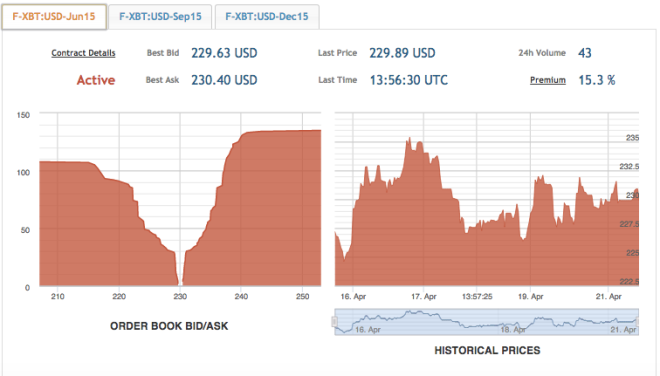
TeraExchange’s live market feed appears to be broken, so here is a snapshot of CryptoFacilities.

Why Meerkat and Periscope are the Biggest Breakout Hits of the Year

Periscope

Our phones are GoPros, thanks to Meerkat. —Semil Shah, overpaid blogger. March 15 2015.

When did the media turn into sales catalogs for shit made by rich people?

Meerkat was never cool. Even at its peak its highest ranking on the US iPhone download chart was 140. Periscope isn’t cool either. Even with Meerkat’s $12M Series A and Twitter’s marketing budget, these are apps that underperformed your average Croatian Flappy Bird clone [1].

Everyone is building their own brand, and the more you pander to the rich and powerful, the closer you might get. Maybe someday they’ll let you touch their hair.

As if being rich makes you smart or infallible. Remember how stupid Andreessen and Doerr and the Google guys looked with their idiotic Google Glass? The tech elite wanted it to be a hit so bad.

You look like tools.

Secret will change communication. Yo is the future of your homescreen. Ello will kill Facebook.

Spouting nonsense is easy. Maybe a TechCrunch editor can do a story about how much of their content has been pitched. Or maybe they can disclose which VC funds their founder has invested in.

But they’re too busy tweeting and blogging about live-streaming selfies as the next big thing.

Great, our phones are now GoPros. Morgan Stanley analysts tried to GoPro themselves doing company research [2]. They learned that their lives are boring and they made a horrible career choice and they should just kill themselves.

And the live-selfie-streaming celebrities are boring too, because 99% of life is boring no matter how rich you are.

The tech reporters will keep trumpeting everything made by people with money — every venture-backed app is great until someone checks the download charts and finds out they’re shit. But it’s okay, you’ll get a free pass. Rich people always do.

Not your life
Not your life

References:
1. Meerkat is dying – and it’s taking U.S. tech journalism with it
2. Morgan Stanley Analysts Try GoPro, Discover Their Lives Are Boring –WSJ MoneyBeat

VC Friend Finder

VC Friend Finder is a tool for users to find out which investors are tweeting about crap you like.

It was supposed to be an experiment for Warren and I to learn to use elasticsearch, but we got lazy and went with Google’s search API instead.

Elasticsearch in version 2.0, we promise! Also, instant topic alerts and autoresponders.

Screen Shot 2015-04-13 at 8.40.36 AM

Now go play with it.

A Cost-Benefit Analysis of Doing Bad Things

So I’ve been reading through bank financials, cuz they’re all reporting earnings next week and I don’t have a lot to do these days. I learned that, wow, bank earnings are heavily impacted by legal expenses. And by “legal expense” they mostly mean nondeductible penalties for doing illegal things.

All banks have established litigation reserves but most keep them secret
(except Credit Suisse, Deutsche, JP Morgan).

Publishing litigation reserves is a lot like saying, Yeah we know we did bad stuff and expect to pay this much in penalties, because we already performed the cost-benefit analysis before doing it.

articleLarge

Are you a bank considering willful violations of the law? Here are some recent settlements to provide basis for your own cost-benefit analysis.

Selling Misrepresented CDOs
Wachovia Bank sells $40M worth of worthless CDOs to LBBW Luuxemburg and an additional $5.5M to the Zuni Indian Tribe. Wachovia agrees to pay $11.2M to settle SEC charges after becoming part of Wells Fargo.
Net Profit: $34.3M

More CDO Securities Fraud
JP Morgan structures $1.1B worth of bad CDOs for $18.6M in fees, sells $150M of them to various investors. JP Morgan agrees to pay $153.6M to settle SEC charges.
Net Profit: $15M, although it also took an $880M loss on the CDOs it *couldn’t* unload, so maybe the Commission thought they had suffered enough?

Selling Subprime Loans
Morgan Stanley sells $2.5B worth of subprime loans. The loans result in $160M worth of investor losses. Morgan Stanley makes $1.1M in underwriting fees. Morgan Stanley agrees to pay $275M to settle charges.
Net Loss: $273.9M

A Shitty Synthetic CDO
John Paulson pays Goldman Sachs $15M to help him make a $1B bet on a synthetic CDO. Goldman Sachs gets two other banks, IKB and ABN Amro, to be the counterparty on that bet. IKB loses all its money and ABN Amro pays Goldman $841M to get out of the losing bet. Goldman Sachs agrees to pay $550M to settle SEC charges.
Net Profit: $306M, although Goldman had to turn most of that $841M over to John Paulson.

Unregistered Stock Exchange Selling Unregistered Securities
Ethan Burnside operates Bitcoin and Litecoin Stock Exchanges. Burnside receives 12081 litecoins and 2141 bitcoins in transaction fees, plus 11450 litecoins and 210 bitcoins in listing fees — a total of $515k according to October 2013 exchange rates. Burnside agrees to pay $68k to settle SEC charges.
Net Profit: $446,291

Never willfully violate the Securities Act without first performing a thorough cost-benefit analysis.