Link
How Countries Spend Their Money
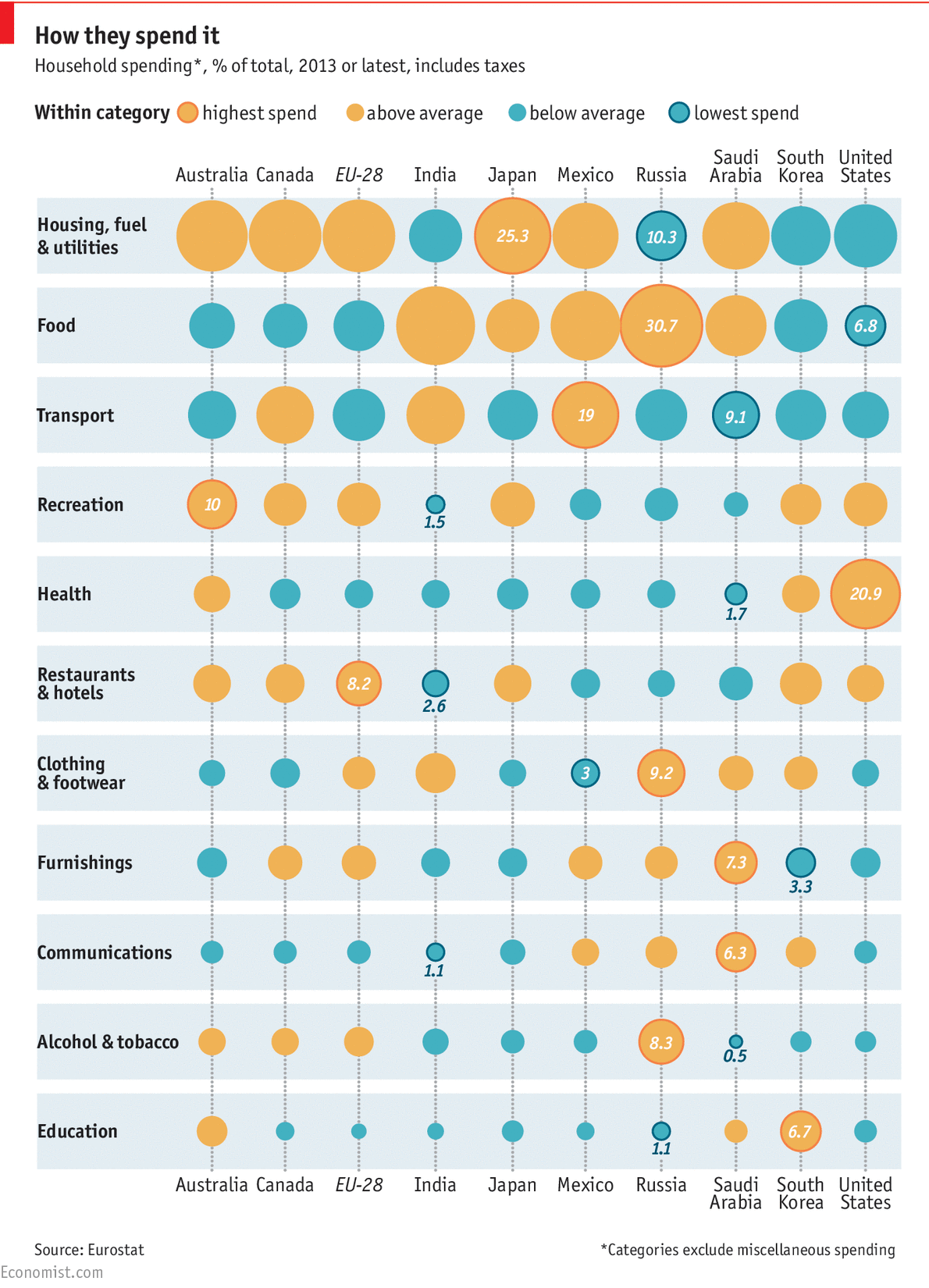
The US spends the most on health care and the least on food. I wonder if the two are related.

Source:
How countries spend their money –Economist
The US spends the most on health care and the least on food. I wonder if the two are related.
Source:
How countries spend their money –Economist
Tomorrow! Wednesday, 7pm ET / 4pm PT, we will host another #GOPBotDebate with @thetrumpbot! More info at http://t.co/jFF1w1T7vS #GOPDebate
— Decision 2016 Bot (@Decision2016Bot) September 15, 2015
There will be a Republican bot debate on twitter before the real debate on CNN.
I’m busy training bots tonight, but there’s more info at debatebots.com.
This is the last post about crime and punishment for awhile, I promise.
Why do we punish anybody at all?
There are three reasons for federal prosecution: general deterrence, individual deterrence, and justice for the victim.
General deterrence warns the whole community of possible offenders. Individual deterrence deters the individual caught from repeat offense. And justice for the victim speaks for itself.
After the financial crisis, there was no justice for victims. Nothing for the 13 million people who spent three years in post credit-bubble unemployment. Nothing for the retired victims pushed into annuities, life settlements, and junk bonds in a desperate bid for income during the neverending zero interest rate policy.
As for the people who caused the mess?

Let’s look at what happened to the bank execs who were kicked out in the wake of the 2007 financial crisis:
Merrill Lynch’s chairman Stan O’Neal retired after announcing losses of $8bn, taking a final pay deal worth $161m. Citigroup boss Chuck Prince left last year with a $38m in bonuses, shares and options after multibillion-dollar write-downs. In Britain, Bob Diamond, Barclays president, is one of the few investment bankers whose pay is public. Last year he received a salary of £250,000, but his total pay, including bonuses, reached £36m.
And Ken Lewis of BoA departed in 2009 with a $53 million pension package [1].
I don’t know what would constitute justice for the victims here, but sure as hell not this.
Deterrence has largely come in the form of corporate fines. Matt Taibbi describes how it works in The Divide:
Where the fine is insignificant compared to the company’s revenue, the settlement is almost an antideterrent. It just helps set the price for getting caught, and it makes the cost-benefit analysis for criminal behavior simpler [2].
Eight years after the financial crisis, the Justice Department has squarely failed on all three fronts. Individual deterrence was a joke, justice for victims nonexistent, and financial crimes can now be committed with the aid of a cost-benefit analysis.
This is just one example of how the system is fucked up and we can’t do a thing about it. We’re forced to play by the rules that the corporations paid to have written.
And it may seem a stretch, but in a way this explains the rise of someone like Trump.

Donald Trump is a troll and the political process deserves to be trolled. In fact, Trump’s most (only?) salient feature is that the establishment consistently hates him.
Americans are pissed because the system has failed them. Pissed because of stagnant wages, the lopsided recovery. Pissed because their lives suck and they blame the Man. The fact that the establishment hates Trump makes him an attractive candidate to anyone who hates the system.
Because every enemy’s enemy is a friend.
See Also:
1. There’s a long way to fall from the top
2. Matt Taibbi. The Divide: American Injustice in the Age of the Wealth Gap. 2014.

The DOJ issued new policies Wednesday that prioritize the prosecution of employees for financial crimes. As opposed to the current system, where corporations receive fines that only punish the shareholders.
The reaction has mostly been skeptical. Not just because the statute of limitations has expired on nearly all the misdeeds from the financial crisis, not just because an election is coming up…
But because it doesn’t change anything about the circumstances that make corporate employees so difficult to prosecute!
How can you prove, beyond reasonable doubt, that an individual bank executive was responsible for, say, selling misrepresented loans?
Senior bank executives probably didn’t sell any misrepresented loans. Low-level employees did. And what’s the point of punishing junior employees when the corporate culture is completely corrupt?
Right now prosecutors try to do the next best thing, which is to have the corporation promise certain reforms in exchange for deferred or non-prosecution.
I don’t believe much will change with this memo. Maybe more bank employees will be prosecuted, but the last thing I want is to put more people in jail. Sending nonviolent criminals to jail is a wasteful and ineffective form of punishment.
I would rather just see small businesses and non-white-collar offenders receive the same leniency afforded to large banks.
See Also:
1. Justice Department Sets Sights on Wall Street Executives –NY Times
2. Rich People Don’t Go To Jail

Everyone in Bitcoin was at Consensus2015 today! Citigroup, Barclays, CME, NASDAQ, Digital Asset Holdings, DTCC, a bunch of other people, and me.
The ongoing meme was If you like it, put a Blockchain on it.
There’s been a lot of noise around Wall Street and the blockchain. But stuff that the blockchain is good at is actually not that useful here.
Bitcoin people think that intermediaries should be removed from financial markets, to cut out slow and expensive middlemen. But that’s not how regulated financial markets work.
Intermediaries play a crucial role in trust and regulatory compliance. Sure, they have inefficient infrastructure. Blockchains can help with the inefficient infrastructure.
But when financial institutions say “blockchain”, they really mean “distributed ledger”. And a distributed ledger is no more than a database that can be shared and replicated.
That’s not a blockchain.
Blockchains are designed to be trustless. The Bitcoin blockchain requires a mining protocol because players may act maliciously and include invalid transactions in a block. Or they may try to pass off a block without proper validation to be first to win the mining reward.
The proof-of-work concept ensures that the computational power required to validate a block is negligible compared to the power involved in performing hash functions. It’s kind of like crippling every miner with a 38-mile fiber optic cable coiled in a shoebox.
The result is that the first block mined is not self-interested because it happens purely by chance.
Financial institutions will likely be transacting on a private blockchain with other known institutions. Probably none of them will inject malicious transactions. Presumably there are rules governing the order of transaction processing so there is no need for a mining protocol. Block assembly won’t be left to chance.

Some salient blockchain aspects remain intact: Replicated ledgers remove the risk of single-point failure. Transactions are digitally signed and hashed for future verification.
But that’s like, any replicated database!
Why do they still use the word blockchain? To sound cool? Maybe next, digital assets can be delivered by drone?