Complex Strategies

So what, exactly, was the London whale’s trading strategy when he lost $5.8 billion for JPMorgan last year?

As documented in his presentation to the JPMorgan International Senior Management Group of the Chief Investment Office:

He proposed to “sell the forward spread and buy protection on the tightening move,” “use indices and add to existing position,” “go long risk on some belly tranches especially where defaults may realize” and “buy protection on HY and Xover in rallies and turn the position over to monetize volatility.”

If it uses lots of complicated words without making any sense, it must be really smart, right?

Investopedia-induced diarrhea is apparently an acceptable investment strategy, so I wrote my own app to generate complex trades.

Dear Banks, feel free to employ my app and then pay me $7 million a year in compensation.
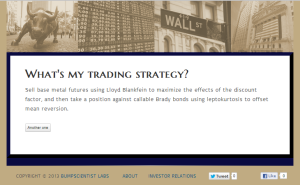
Complex Strategies

Masked by Gibberish, the Risks Run Amok –NY Times

Find The Thing You’re Most Passionate About…

30 million Americans can’t be wrong:

You need to find the one interest or activity that truly fulfills you in ways nothing else can. Then, really immerse yourself in it for a few fleeting moments after an exhausting 10-hour day at a desk job and an excruciating 65-minute commute home.

Find The Thing You’re Most Passionate About, Then Do It On Nights And Weekends For The Rest Of Your Life — the Onion

Nothing is Sacred Anymore

I thought this clip from last week’s Family Guy episode was pretty awesome:

[vimeo http://www.vimeo.com/62215117 w=500&h=375]

It’s true. Phones offer a level of discretion unmatched by tablets or newspapers. Reminder to self: Never borrow anyone’s phone ever again.

This also represents a huge degradation in social communication. When I’m writing to someone on Google chat, or reading an email, now I can’t help but wonder if my correspondent is on the toilet.

The Marginal Utility of Time

I had dinner with a very dear friend last night. He had recently received a $264,000 job offer from a tech company up the street, but turned it down after receiving an even better offer elsewhere.

OH MY GOD, I said. Is that what people are making in the Bay Area these days??

You could easily land something similar, he said. I could recommend you for the position I turned down. You just have to promise not to quit your job again after four months. That would make me look bad.

Damn. I had to think about it pretty hard. When I was at Intel, I was working over 50 hours a week for less than half that salary. Adjust for taxes, benefits, and vacation time, and I’d estimate that I was pocketing at most $45 for each hour of work.

Chump change. The decision to quit was easy, because I derive more than $45 worth of enjoyment value for each hour that I spend to myself.

But just how much more? Now that I’m unemployed, it’s especially hard to compare the marginal utility of my time against the value of previous hours.

The job comes with free food, he said. (He knows me so well.)

If the job didn’t suck, they wouldn’t have to pay someone $264,000 a year to do it.

No, thank you, I said. My time is still worth more than that. I think.

Besides, golden handcuffs are very difficult to shed.
Golden handcuffs

ALPS US Equity High Volatility Put Write Index Fund

Two weeks ago, ALPS launched a new ETF that sells 60-day listed put options on 20 of the largest high-volatility stocks (HVPW).

Every 60 days, it will distribute 1.5% of its net assets to investors.

According to their prospectus, the options will be sold against 3-month US Treasury bills to cover their asses when options get exercised.

It also has an expense ratio of 0.95%, compared to the industry average of 0.44% for ETFs and 0.74% for index funds.

How much longer until ETFs get rebranded as hedge funds for the masses? Anyway, this should be fun to watch.