The Imaginary Block Size Debate

Bitcoin’s block size debate is not a debate. Everyone agrees on the need for a size increase.

The Bitcoin developers set a scalability target of 4000 transactions per second, approximately Visa’s daily peak rate. The question is how to get there.

Three of the five core developers have published contending Bitcoin Improvement Proposals (BIPs).

  • BIP 100 (by Jeff Garzik) removes the current block size limit and allows miners to vote on size upgrades every 3 months, with a hard limit of 32 MB.
  • BIP 101 (aka Bitcoin XT, by Gavin Andresen) increases the size limit to 8 MB and doubles it every 2 years until 2036, when it reaches 8,192 MB (8 GB).
  • BIP 103 (by Peter Wuille, co-founder of Blockstream) increases the block size by 17.7% every year until 2063.

They are all fine proposals. They are all based on gratuitous assumptions about the long-term growth prospects of CPU power, storage, and Internet bandwidth.

Next decade’s technology is an unknown variable. Fine, the developers fill the blanks with guesses. But guesses are merely expressions of prejudice.

Whether we’re arguing a block size increase of 2 MB or 8 MB or how soon, who cares? It’s software! No decision is irreversible!

The important thing is if there’s a decision at all.

On Monday, Bitcoin industry leaders signed a statement supporting BIP 101:

We have found Gavin’s arguments on both the need for larger blocks and the feasibility of their implementation to be convincing.

Wow, what an endorsement. The corporations need consensus, their business depends on it. The block size debate is a Keynesian beauty contest, and industry leaders are backing the loudest candidate.

But they should have checked with the miners.

The largest miners had been casting votes for BIP 100 long before the Bitcoin XT announcement. BIP 100 grants them the most control, but they really just want consensus too.

Keep it up. If the deadlock continues, Bitcoin users will lose trust in the system and leave. And then there will be no transaction target to worry about at all.

The miners vote using an open field in the block headers.
Left: Blocks mined in the last 24 hours.
Right: Blocks mined in the last week.
“Default” is more of an abstention than a vote for the status quo. A lot of miners are voting specifically for 8MB, which was the topic of an earlier debate.

John McAfee on the Ashley Madison Hack

ashley-madison

According to John McAfee (of McAfee Antivirus), it was a disgruntled employee in the IT department:

From the data that was released, it was clear that the perpetrator had intimate knowledge of the technology stack of the company. For example, the data contains actual MySQL database dumps. This is not just someone copying a table and making into a .csv file. Hackers rarely have full knowledge of the technology stack of a target.

There were countless ways the “hackers” could have ransomed the data. Instead, they only demanded that the website be shut down.

It’s sad that people who were exposed as AshleyMadison users are killing themselves. Even sadder for their survivng spouses.

Interesting aside: Hedge fund billionaire Dan Loeb had an account on AshleyMadison. When asked about it, he claimed it was for research, because he had invested in IAC (parent company of Tinder and match.com). His research involved creating a profile and checking for messages. That is some comprehensive due diligence. No wonder he manages a $14B fund.

How many startups are trophy assets?

bubble

Journalists have been marveling over the recent valuation of the Economist after Pearson PLC sold half its stake for $738 million. Could the Economist really be worth $1.5 billion, which is more than the Financial Times ($1.3B), and 6 times Washington Post ($250M)?

Pearson called The Economist and FT trophy assets. Trophy assets are expensive ego-driven toys, like buying sports cars or sports teams.

BuzzFeed is another publication that has a $1.5 billion valuation, according to last week’s $200M investment.

There is an important distinction, however. The Economist and FT have both online and print circulations, and BuzzFeed serves up horse vomit.

I wouldn’t call BuzzFeed a trophy asset though. No brand loyalty. Subscribers to The Economist regularly return for the latest information. People aren’t going to load up buzzfeed.com to find the latest clickbait.

BuzzFeed is more like a bet on a sustained tech bubble.

financial-times-germany-g-j-wirtschaftsmedien-financial-times-newspaper-financial-times-bubble-outdoor-251524-adeevee

There is a hedge fund in SF that invests in the public-company counterparts to hot private startups. For example, HomeAway ($AWAY) with a $2.8B market cap instead of Airbnb at $24B. Or Pandora ($P) at $3.8B instead of Spotify at $8.5B.

Let’s say I’m a rich person looking to allocate some assets. What sounds more attractive?

Hedge fund A: We can buy you some shares of BOX, which is trading at a discount to its private company peers.

Hedge fund B: We can get you some super hot pre-IPO shares in Dropbox.

When enough people choose Hedge fund B, a trophy asset is born.

See Also:
Storied Asset Sales: Valuing and Pricing “Trophy” Assets –Aswath Damodaran

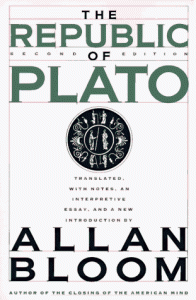
Plato’s Republic and the Bitcoin Civil War

plato

Today I read Plato’s Republic while, uh, waiting for code to compile.

Previously, Izabella Kaminska pointed out that Bitcoin’s governance has analogues in anacyclosis, the ancient Greek theory of political evolution. Anacyclosis is a progression from Monarchy to Kingship to Tyranny to Aristocracy to Oligarchy to Democracy to Mob Rule.

Bitcoin is now at a political impasse as the core developers jockey for power under the guise of a technology debate.

According to Plato, the ideal (maximum justice) city is ruled by an all-knowing philosopher king. In ancient Greece, philosophers were physicists who came up with mathematical formulae to explain the universe, not the deadbeats we think of today.

Because the king wholly understands the universe, he is most fit to govern. This is an aristocracy, literally “rule of the best”. In Plato’s world, Stephen Hawking would be king.

The rulers have no possessions because they only desire knowledge. Over time, mistakes are made in choosing successors, and less altruistic people rise to power. They allow themselves some wealth as reward for their knowledge-seeking virtues.

This eventually decays into oligarchy. The rich and powerful want to preserve their wealth so they restrict poor people from political influence. The rulers are afraid of the people, and the people hate the rulers.

Finally, the poor people revolt, kill the wealthy, and install a democracy.

Even in a democracy, there will be a natural wealth gap. This is okay until the poor people start thinking that the rich are in fact oligarchs. Tension builds until someone leads the underclass to revolt. Charles Manson was trying to trigger this underclass revolution with his Helter Skelter murders in the 60s.

Plato foresaw that the leader of the revolution would turn the city into a tyranny. He did not predict that the tyrant would be Charles Manson.

Bitcoin started with Satoshi Nakamoto as philosopher king. The five core developers constitute an aristocracy. However, the true power lies with the mining pools in China and Iceland, who provide over 70% of the Bitcoin hashing power. The Chinese ASIC miners don’t care about the ongoing squabble because their hashing power puts them light years ahead no matter who controls the core.

If Bitcoin politics mirror Greek philosophy, we’re in for a revolution. We will abandon Bitcoin and adopt a more democratic protocol like Ethereum. Ethereum’s mining function is memory-bound, meaning computation speed is limited by memory access. Custom hardware has less advantage because you can only put so much memory in silicon.

When even Ethereum fails to provide justice, then maybe we will adopt the tyranny of the US dollar.

References:
1. Plato. The Republic. 360 B.C. –The Internet Classics Archive
This translation reads like a bad Tom Stoppard play. But maybe that’s just Plato

2. Bitcoin in the Headlines: Fork-load of Drama –coindesk

3. I thought this was a helpful interpretation:

717MCD1E3VL

Overcriminalization of the 99%, Undercriminalization of the 1%

Hey! Remember that time we declared a War on Drugs, and threw 5% of the US population in jail, and then there were no more drugs?

Too bad, because I could really use a joint right now.

We’re doing prisons wrong.

We’re supposed to use prison as a threat to deter crime. We’re not supposed to actually do it to one in 20 people!

The threat of punishment is more powerful than actual punishment. That’s why the US has nuclear weapons to wave around, but doesn’t use them (except maybe on Japan).

Incarceration is an ineffective threat not because prison is too nice, but because it’s too uncertain. Here is a fun tool that calculates your expected prison sentence based on the crime committed. But let’s be honest here: Your prison sentence is entirely a function of how much you pay your lawyer and, unfortunately, the color of your skin.

Criminals have no reason to believe that crime leads to punishment. Just a vague chance of punishment.

To reduce crime, increase certainty. In California, repeat offenders are less likely to commit a third offense thanks to the 3-strikes rule, which automatically gives 3-time offenders a life sentence.

It doesn’t actually matter what the punishment is. Place the criminal in a pillory and pelt him with dead cats, whatever. If it’s scary enough and certain enough, people will behave to avoid it.

Confinement only makes sense if a criminal is so dangerous that he needs to be kept locked up, away from society. This is not preschool where we give bad kids a time-out so they can think about what they did.

We’re doing white-collar justice wrong.

You can’t throw a corporation in jail, but you can prosecute it in court.

Arthur Andersen LLP, the accounting firm that helped Enron destroy documents, was convicted of obstruction of justice in 2002. The SEC cannot accept audits from convicted felons, so the firm surrendered its right to practice and went out of business. That threw tens of thousands of people out of work, most of whom had nothing to do with Enron’s accounting.

A corporate indictment is like dropping an atomic bomb on Hiroshima. It gets the job done, but it mostly destroys innocent civilians. Corporate leaders effectively use their employee workforce as a human shield against prosecution.

But in the past year, most major banks earned criminal convictions. The Justice Department was worried about that for awhile. Lucky for them, the SEC negotiated waivers that meant banks can conduct all their business as usual, even being criminals and all. That sounds unfair, but the collateral consequences of JP Morgan Chase going out of business probably suck.

That’s why most corporate cases go straight to settlement. The corporation pays a fine and nobody goes to court. Government agencies prefer this because, let’s be honest: Fancy bank lawyers do better in court than taxpayer-funded lawyers.

Remember that time the SEC fined Goldman Sachs $550 million for contributing to the financial crisis and everyone was like whoaaa…? Michael Lewis was only half-joking when he said that at Goldman, accounting always rounds to the nearest $50 billion.

$550 million rounds to zer0. When the government bailed out AIG during the financial crisis, $12.9 billion went to Goldman Sachs. $12.9 billion also rounds to zero.

A settlement is annoying enough to want to avoid it, but it’s not a big deal unless you’re poor. It’s kind of like getting a speeding ticket. You know, if speeding tickets were paid for by your shareholders.

See Also:
1. In America, mass incarceration has caused more crime than it’s prevented –qz.com
2. Get Out of Jail Free: How prosecutors and courts collude to keep corrupt executives from doing prison time. –prospect.org