The United States Information Agency, on Steroids

America is under attack. Cyber attack, that is. Throughout the past year, the Russians have spread wave after wave of fake news in an attempt to influence American voters.

National Intelligence Director James Clapper says the US needs to counter these attacks with our own propaganda. We need to bring back the US Information Agency, he says. Except this time, “on steroids”.
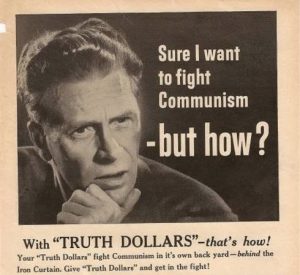
Now, I know the word “propaganda” carries a negative connotation, but don’t let that dissuade you. Former USIA head Ed Murrow said propaganda is fine, “so long as that propaganda is based on the truth.” And if there’s anyone we can trust to be a fair arbiter of the truth, it’s a government agency.

Let’s take a look at the US government’s long history of helping the public understand the truth.

Here’s a 1944 documentary about Japan and how Shintoism is a dangerous religion that drives the Japanese to become bloodthirsty imperialists hell-bent on world domination. Boo!!

It mostly features footage from old samurai movies and bad translations read in a Mickey Rooney accent. Americans didn’t know much about Japan in the 1940s and struggled to understand why the Japanese bombed Pearl Harbor. The fact that we cut off their oil supply might have had something to do with it. The film leaves that part out and blames it on Japan’s desire to conquer America.

This part talks about how Japanese people play a combative board game called Go, which teaches them military strategy. I wonder if we should be extra worried about evil AI now.

Plotting the invasion of China

The Defense Department also made a documentary about Germany. America had a large population of ethnic Germans so it was harder to completely make shit up. The film focuses on Prussia’s history of territorial expansion. Frederick the Great and Otto von Bismarck conquered neighboring states by force! Not like their neighbors in France and Britain, who settled colonies through kindness and generosity.

Germany’s warmongering culture meant that as soon as Allied forces withdrew after World War I, the Germans started remilitarizing and planning for world domination again. The biggest mistake of the Versailles Treaty was allowing these people to have their own country. 😠

Our Defense documentaries weren’t all negative. Here’s a 1943 film about our friends in Russia. It shows different ethnic groups dancing and playing musical instruments, and explains how people in Moscow, Ukraine, Moldova, Armenia, Georgia, Kazakh, Kirghiz, and Turkmen all share a common love of their Soviet Republic. Poland is conveniently never mentioned anywhere. Maybe they love the USSR a little bit less.

It’s because Russia is so rich in culture and natural resources that a long history of aggressors keep trying to conquer it. From the Teutonic Knights in the 13th century to the Swedes in the Great Northern War, Napoleon in 1812, and Kaiser Wilhelm in WWI, everyone keeps beating up on these innocent peasants. Now Hitler wants to take Moscow. We have to go stop him!! 🙁 🙁 🙁

Do we really need a new Information Agency? Can’t we just reuse the stuff our tax dollars paid for last time? It’s not like the truth ever changes, or anything.

Musket Ball Money

Celtic arrowhead money, Black Sea Region ~600 BC.

I’m of the belief that if you have a sufficient supply of guns and ammo, you don’t need money. Money is an instrument of persuasion, and what could possibly be more persuasive than the business end of a rifle?

Back in the early days of New England, colonial governments had to deal with the problem of insufficient coinage. Citizens were accustomed to transacting in shillings and pounds and pence, but lacked the actual coins to do so.

After fumbling about with different types of commodity money, in 1634 the Massachusetts general assembly made musket balls a legal tender:

It is likewise ordered that muskett bulletts of a full boare shall pass currantly for a farthing apiece, provided that noe man be compelled to take above XIId at a tyme in them.

This was great. Everyone needed ammo for hunting game and defending against Indians. But bullets weren’t needed in mass quantities, unless you were planning to field an army. So musket ball acceptance was only compulsory up to, uh, XIId (I think this means 12 pence, or 48 bullets) at a time.

Lead balls are heavy, and this currency was unfortunately unscalable. You couldn’t very well pay off a large debt by dropping a cannonball on the creditor’s desk. In 1643, the Massachusetts court added:

It is Ordered, that Wampampeag, shall pass currant in the payment of debts to the payment of forty shillings, the White at Eight a penny, the black at four.

Black wampum was more valuable than white wampum due to its relative scarcity.

So you could pay up to 40 shillings, or 480 pence, in wampum. This was canceled by 1661 because markets were flooded with low quality wampum. In 1690, the Massachusetts government started issuing paper bills of credit and commodity money was banned.

Bullets remain timeless.

References:
C. Priest. Currency Policies and Legal Developments in Colonial New England. 110 Yale Law Journal 1303, 2001.
The colonial laws of Massachusetts : reprinted from the edition of 1660, with the supplements to 1672
A bibliographical sketch of the laws of the Massachusetts colony from 1630 to 1686. In which are included the Body of liberties of 1641, and the records of the Court of assistants, 1641-1644.

Theories on the Origins of Money

Or, how little bits of metal became a social and institutional technology.

Bronze imitation cowries. Zhou Dynasty, ~900 BC

This is a list of references. It is a work in progress and suggested additions are welcome.

Chartalism

The idea that money is a creature of law, and money originated from some powerful entity’s desire to control economic activity.

State

States created tokens so that they could extract value from people. If people are forced to pay tax tokens to the state, then people will want to be paid in tokens themselves.

Credit and Debt

Money originated in ancient penal systems to pay restitutions for wrongdoing. Alternatively, money originated to provide a unit of account for measuring wrongdoing.

Metallism

The idea that the value of money derives from the purchasing power of the commodity upon which it is based, and emerged from human action, not state decree.

Marginal Utility

In early barter systems, humans learned that some goods were more “saleable” than others – that is, they had greater trading, or purchasing, power. The most saleable commodity came to be used as money because it offered the most marginal utility.

Regression

The expected future purchasing power of money explains its current purchasing power.

Trust-Minimization

Early humans collected and transferred durable goods of unforgeable costliness to enable mutual cooperation between untrusting parties.

Other

Information

The value of money is its authenticity and reliability as a measuring stick of economic activity.

Google’s Anti-Semitic Search Queries

Earlier this month, The Guardian broke the news that Google was being subverted to promote neo-Nazi propaganda. Check it out:

Google has since “fixed” its search function, and Stormfront’s Holocaust-denial site has been expunged from the first three pages of results.

Who actually searches for “Did the holocaust happen”? People who are legitimately confused as to whether the Holocaust happened, or social justice warriors in search of moral outrage?

Here’s the Google search trend for “Did the holocaust happen”:

For over five years, virtually no one was confused about whether or not the Holocaust happened. Most Americans with a middle-school education probably didn’t even realize this was up for debate until The Guardian brought it to our collective attention.

Even so, “Did the holocaust happen” is a query that gets entered about 1600 times a month, or roughly 50 times a day – out of Google’s 5.5 billion search queries per day. The number is dwarfed by the 15,000 daily queries for “holocaust”, which is a far more plausible search query if you genuinely don’t know anything about the Holocaust.

Google’s search rank algorithm (RankBrain) is an industry secret, but it’s known to weight click-through rate: Search results that get clicked on will appear higher in subsequent results. As a result, infrequent queries are easy to game because all it takes is a small team of distributed trolls to push a desired result to the top, with few honest queries to offset the mess.

The same thing happened when the internet blew a gasket over allegations that Google’s autocomplete suggested that Jews might be evil. Who the crap types that into a search engine? The few people obtuse enough to seek answers to such a query are probably asking their buddies on 4chan, not Google.

The popularity of the “Are jews evil” search also coincides with the corresponding Guardian article, and the people most curious about this topic reside in New York, Seattle, and San Francisco. I blame the public schools.

Anyway, it looks like Google isn’t fixing anything; all it’s doing is adding exceptions for the specific searches that people bitch about. Even though results for “Did the holocaust happen” have been cleansed of Holocaust-denial sites, variations have not.

If I search for “Did the holocaust really happen,” cuz, you know, I want to be *really* sure, then the second result is a youtube video that purportedly debunks the Holocaust as a hoax. And if I search for “Did the holocaust ever happen,” then Stormfront comes back up again.

Google can’t optimize its search algorithm to account for the 0.000001% of problematic queries that people might type in. There are infinite combinations of words that will inevitably offend somebody somewhere. In this case, Google put forth the minimum possible effort to get people to shut up and go away, and even that was probably too generous.

Death of the Unfettered Press

Augh, nothing’s worse than being a two-star major general about to lead a campaign into Vicksburg, only to have some pesky news reporter expose your location and foil your plans.

The Civil War was the first major war to take place in the era of the free press. Early newspapers were expensive to print and required political sponsors, making them little more than partisan outlets delivering messages from wealthy politicians.

Lincoln controlling the press, published in a Copperhead paper

The invention of the steam-powered printing press in the 1830s changed that business model. Low production costs meant that journalists could write content for the working class, who cared less about Congressional proceedings and more about gossip. Wider circulation made advertising an attractive source of revenue, so papers focused more on what the people wanted to read and less on what stories politicians wanted to tell.

The New York Times, one of the first penny-press tabloid rags

People were especially interested in Civil War gossip because many had family members on the battlefield. Thanks to the completion of the transcontinental telegraph line and the railroad boom, reporters could head to the front lines and relay information back to local publishers, who would circulate new developments within hours.

This was bad for military commanders, who wanted to protect their operations from enemy intelligence. Senior officers knew that victories on the battlefield could lead to a position as commander-in-chief, especially if the media enhanced their reputation. If commanders denied reporters access to coverage, the press could retaliate by destroying their political careers.

Nutjob.

General William T. Sherman was one of the top Union generals, but he forbade reporters from accompanying his troops. The newspapers responded by portraying him as a hallucinating lunatic. Major General George Meade led the Union victory in the Battle of Gettysburg, but after he evicted a reporter on a mule, several journalists got mad and formed an embargo. From then on, all of Meade’s successes were credited to Ulysses S. Grant, while any setbacks were attributed to Meade. General Meade goes down in history as a goggle-eyed snapping turtle.

After the war, the most press-friendly generals became the next four elected presidents: Ulysses S. Grant (twice), Rutherford B. Hayes, James A. Garfield. The latter two were far less instrumental to the war than Generals Meade and Sherman, but they were really good at establishing relations with the press.

Stronger government controls weren’t enacted until the 1917 Espionage Act, shortly after US entry into World War I. President Woodrow Wilson insisted, “Authority to exercise censorship over the press is absolutely necessary to the public safety.”

It’s been a long time since the US fought any war that had anything to do with the safety of the country, but Vietnam taught us that the best military strategy is to limit the flow of information to the public. Lyndon B. Johnson’s biggest mistake was to claim that the Vietnam War was not a war, which meant that censorship controls were unnecessary. Free-roaming journalists brought footage of all sorts of death and dismemberment into American living rooms, which made people unhappy.

Staged media event.

Pictures of body bags are bad, civilian death counts are bad, even footage of coffins is bad. Today we have embedded journalism, where carefully screened reporters are attached to military units and release staged photos and pro-war propaganda. No one in the media has a clue what’s going on, so unnamed government officials helpfully fill them in. Mainstream media have returned to being lightly edited press outlets for government agencies, just as they were two centuries ago. Is it any wonder no one reads their nonsense anymore?

See Also:
Randy Ferryman. The Unresolved Tension between Warriors and Journalistsduring the Civil War. Studies in Intelligence Vol 58, No. 3 (September 2014)