Your Economy or Your Life

Can we stop presenting this as a binary option? Let’s be honest about which people are actually gonna die. I’m not talking about the old or infirm. I’m talking about the subset of the population that live in dense urban outposts, the ones who commute by public transport in subterranean ant tunnels. By day, they’re cheek-to-jowl in open-plan offices, each inhaling the exhaust fumes of the next. At night, they cluster into highrises like bats in a cave.

See? Not you. You bugged out months ago to your sprawling estate in the Hamptons. You’ve never set foot in an open office; you’ve got your corner suite in Greenwich. And even if you do contract the virus, you’ll be fine. Virologists refer to infectious diseases as “poor man’s disease”. Cuz rich people don’t die from viral infections.

You think Prince Charles or Sophie Trudeau are gonna die? Pfft. Cancer, now that’s a rich man’s disease. Cancer doesn’t care about wealth. That’s why everyone cares about cancer.

So your chances of dying from COVID-19 are veritably nil. But in an economic recession, YOU have the most to lose. In absolute terms, that is. Why should your stock portfolio suffer for the shitty life choices of others?

Then again, maybe you’re one of those bat-colony people. The ones who live and work in close quarters with proles. Maybe you don’t want your Grandma or anybody else’s Grandma killed by a virus. Maybe you know someone who tested positive for COVID-19, or you follow someone on Twitter who tested positive, or maybe you’ve enjoyed a movie starring someone who tested positive. For you, it hits close to home. This shit is real.

Then you see this Oxford study that says coronavirus may have already infected half the UK population. And WSJ says we’ve been overestimating the fatality rate. And look, New York just saw a decrease in the number of new confirmed cases. Coincidentally, doctors have been instructed to stop testing patients unless the patient requires hospitalization. The assumption is that New Yorkers have all been infected already. Maybe that was the peak. Maybe the disease has spread far and wide, and we’ve all developed herd immunity.

Soon, instead of reporting on every tragic death, the papers will begin telling triumphant stories of patients who fought the virus and made a full recovery. Deaths become statistics. You scroll through Twitter and no one’s talking about COVID-19. Toilet paper and hand sanitizer are back on store shelves. Election season regains dominance over national attention. One day, like a miracle, the virus disappears.

And then you realize that this was never about saving lives versus the economy. There was never really a choice at all. Civilizations around the world have spent thousands of years telling stories of angry vengeful gods, unseen and unpredictable forces, stories written by the rich and powerful persuading the proletariat to stay scared and docile. It was never about coronavirus. It was all just a bunch of fanciful storytelling to make you soft and pliable, numb to the fact that you were gonna kneel before zog no matter what.

Censorship in the Time of Corona

Last week, a coterie of the biggest tech platforms announced that they would be teaming up to combat misinformation about coronavirus and the Covid-19 illness it causes. We’re from Google and we’re here to help — the most terrifying words in the English language.

Sure enough over the weekend, blogging site Medium “helpfully” removed a longform post by an armchair epidemiologist who was a bit too optimistic in interpreting COVID-19 data.

The underlying data was correct – it was his opinion that was wrong.

The post (which now reappears on Zerohedge, whose Twitter account was also helpfully banned for COVID-19 misinformation) concludes that school closings and stay-at-home measures do more harm than good, and that we should all calm down and stop the hysteria.

Look, I sympathize with cities like New York where hospitals are inundated and they really need everyone to comply and shelter in place. At the same time, censorship doesn’t work. Half of Americans already distrust media coverage of coronavirus; censoring alternative viewpoints is only going to make that worse. When you censor someone, they instantly go from armchair epidemiologist to SILENCED WHISTLEBLOWER.

Censorship is the ultimate vindication that you’ve spoken truth to power. Remember that Google diversity memo? The author was fired after publicly criticizing the company’s reverse-discrimination efforts. After the fallout, James Damore took to Twitter using the handle @Fired4Truth and republished his document at Fired4Truth.com. No, Damore wasn’t fired for telling the truth – he was fired for causing a PR nightmare. But just as everyone is the hero in their own story, every censored voice is the silenced truthseeker in his own narrative.

If your spouse asks you whether her dress makes her look fat and you answer truthfully, you’ll be sleeping on the couch for the next two weeks. And no, you weren’t banished for “truth” – even though it might feel that way! – you were banished for causing marital discord.

And so, the Evidence-Over-Hysteria post wasn’t removed for factual (in)correctness, it was removed because it racked up several million pageviews and encouraged people to question mandatory shelter-in-place orders. Instead of censoring disruptive posts, it might be worth pondering why people are so skeptical of prevailing narratives in the first place.

Confidence Crunch

My brother’s hospital ran out of masks this week because patients kept breaking into storage cabinets and stealing them. So now doctors have to supply their own masks, respirators, and other protective gear.

There have been other reports of hospitals getting burglarized for masks. Why would anyone steal from a hospital? Is this what it looks like when you give up on having a functional society?

We take a lot of cooperative behavior for granted. Left to our own devices, humans have the cognitive capacity to form cooperative relationships with about 150 others. Dunbar’s number.

Stuff like religion and government enable social scalability so people can collaborate outside of their immediate acquaintances. It’s easier to trust strangers if you believe that some greater force exists to exact justice. The force doesn’t have to be real – Roman banks stored silver in weakly-guarded temples – but the belief has to be universal for societal trust to exist.

We can cooperate with strangers as long as we trust the government to maintain order. When times are good, we play nice and what goes around comes around. In times of crisis, trust runs scarce and government entities step in as the confidence-bearer of last resort.

But now we see that the federal government is powerless to do anything but print money. When the only tool you have is debt monetization, every problem looks like a credit crunch. When people lose faith in the government, they show it by turning on each other.

Decentralize all the Thingz (part 2)

Coronavirus cases by county, as of March 13.

Here’s how Trump gets reelected: Declare emergency funding for immediate dispersion. By which I mean, pay people to disperse from dense, disease-ridden cities. A decentralized country is an antifragile country.

Yes, cities are more efficient… Efficient at spreading disease.

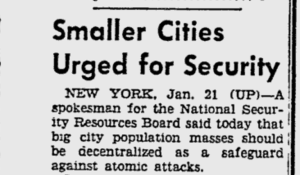
After World War II, there was a huge housing shortage as materials and resources had been diverted to the war effort, and people crowded into cities for defense jobs. The government didn’t care about lack of housing or crowded slums, but they did care about the post-war threat of nuclear attack.

In 1950, the National Security Resources Board received $23 billion (the equivalent of $250 billion today) to incentivize industrial dispersion. Defense contracts were awarded contingent on relocating manufacturing facilities to the midwest.

The Pittsburgh Press, Jan 21 1949

Trump could be more strategic about it – provide relocation grants to Michigan, Pennsylvania, Wisconsin, Ohio – places where no one wants to live, but which might swing an election.

At this point, there’s no reason to continue living in a dense coastal city. Employers have enacted mandatory work-from-home policies, and if you live in San Francisco your home probably sucks.

Here’s a story of how Tulsa, Oklahoma attracted a bunch of remote workers with a $10,000 bribe. It’s like the Zappos Downtown Project, where Tony Hsieh sunk $350 million in an attempt to build an innovation hub in Las Vegas. Attempts to create an urban hub in the desert, or out in the Great Plains, overlooks the one redeeming feature of these places: Cheap land.

Dense cities are out; sprawling homesteads are in! We spend $20 billion per year on agricultural subsidies so that farmers can grow cheap corn for exports to China. Now that we’re closing off trade with China, let’s reclaim the land and disperse the people, Little House On The Prairie-style.

The original Homestead Act granted 160 acres per household – that’s how much land it used to take to feed a family – but today we have GMOs, chemical fertilizers, and Monsanto. You can feed a family of four on only two acres, and still have room for an in-law unit!

I know, I know. We’ve all grown accustomed to the niceties of urban living. Walkability, cultural capital, fortuitous social encounters. Densely-packed nursing homes where we can dump off our elders. Division of labor taken to a ridiculous extreme.

Cities are unnatural. Back in our hunter-gatherer days, humans were about as densely populated as bears. Maybe Darwin will run its course, ravage the cities, and weed out those with an affinity for vibrant arts scenes. When it’s over, only the antisocial losers will remain.

Dynamism (part 2)

A reader points out that the Axis powers suffered an oil embargo during WWII, forcing Japan and Italy to develop fuel-efficient vehicles. (Meanwhile, the Nazis figured out synthetic fuel.) The technologies that enable fuel efficiency lend well to high performance race bikes and sports cars, where power-to-weight ratio determines cornering speed. Hence the overrepresentation of Axis powers on Superbike and F1 podiums.

On the other hand, NASCAR has long been dominated by US auto manufacturers, with Chevy, Ford, and Dodge racking up the most historical wins. See, American engineers can build fine cars if they put their minds to it! Lol just kidding: NASCAR members banned foreign vehicles from participation to avoid competing with superior cars. Toyota was finally allowed to race in 2004, after complaining that all the “American” cars were made in Mexico anyway.